
Tipico in Malta: licence, locked accounts and evidence
A locked account can turn an ordinary sign-in attempt into an urgent question: is the balance safe, is the restriction a verification step, and is the website really operated under the licence it displays? The verified records support a green identity signal for the precise combination of tipico.com, Tipico Karlsruhe Ltd and MGA/CRP/972/2022. That signal establishes a current regulatory match checked on 21 August 2026; it does not guarantee immediate account access, successful withdrawals or the outcome of an individual dispute.
Verdict: legitimate identity, case-specific account risk
For the question “is Tipico scam or legit in Malta?”, the available primary evidence favours legit in the narrow and important sense of regulatory identity. The exact website address is associated with the named company and licence in the captured Malta Gaming Authority result. Malta also has a statutory gaming framework under Chapter 583 of the laws of Malta.
| Question | Evidence-led answer | Important limit |
|---|---|---|
| Does the exact website address match a current MGA record? | Yes, according to the captured exact-address query checked on 21 August 2026. | A later change must be checked against the live record. |
| Which company is named? | Tipico Karlsruhe Ltd. | This does not identify every payment processor or service provider involved in an account. |
| Which licence is supplied? | MGA/CRP/972/2022. | No expiry date was supplied, so none should be assumed. |
| Does a green signal prove every withdrawal will be paid immediately? | No. | Withdrawal timing, verification status and an individual balance were not independently tested. |
A locked account does not by itself establish fraud. Restrictions can arise during identity, age, payment-method or security checks, but no operator statement explaining a specific restriction was supplied. The correct approach is to preserve evidence, verify the exact address independently and request a written account-specific explanation.
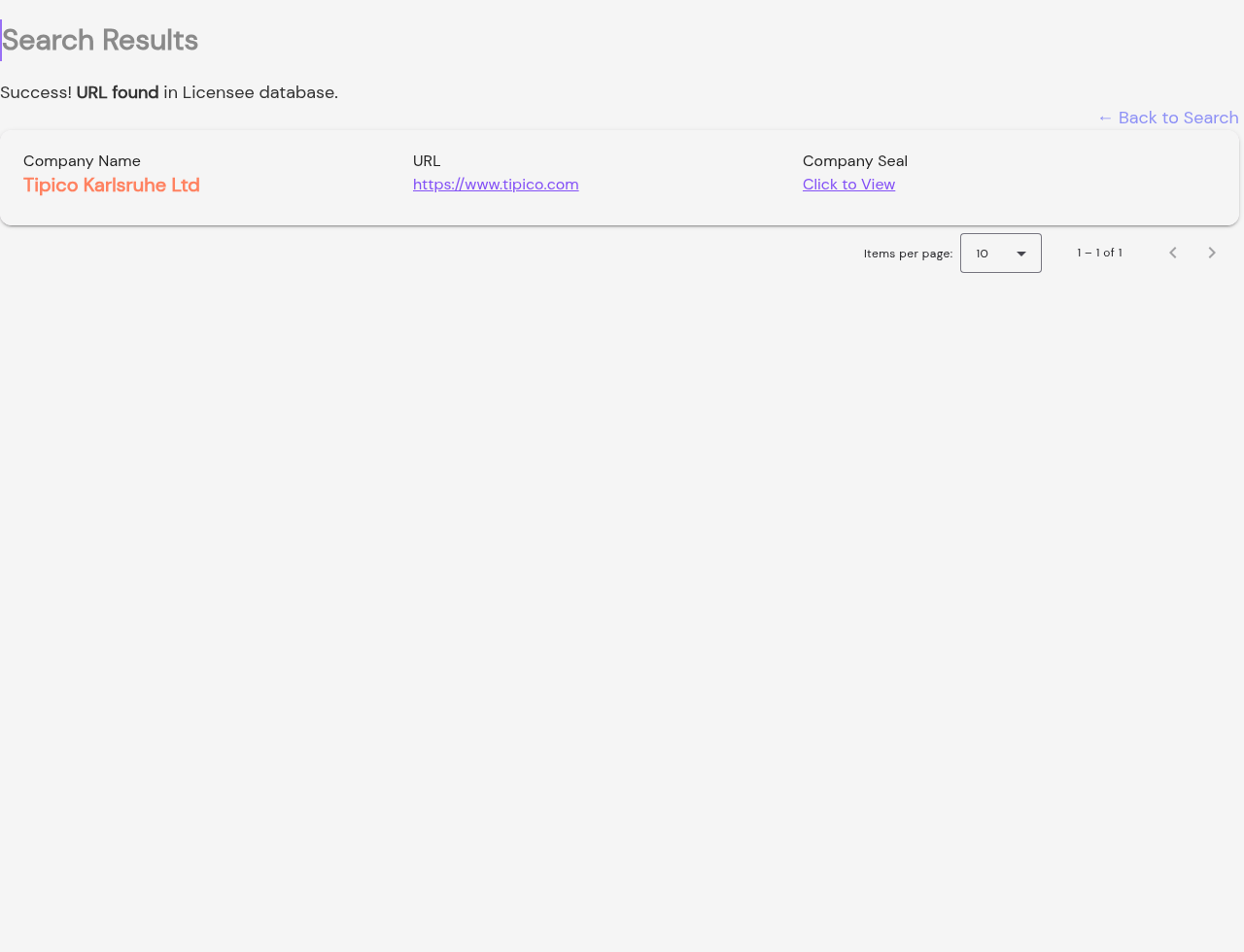
Exact address, company and licence match
The strongest evidence is the exact-address result rather than a familiar name, logo or search-engine advertisement. The verified combination is:
| Identity field | Verified value | How to use it |
|---|---|---|
| Website address | tipico.com | Type or inspect the address carefully before signing in. |
| Licensed company | Tipico Karlsruhe Ltd | Compare it with the legal identity shown in account terms and correspondence. |
| Licence reference | MGA/CRP/972/2022 | Search the reference and company in the regulator’s live tools. |
| Primary check date | 21 August 2026 | Recheck if acting after this date or after any ownership notice. |
The MGA’s exact-URL checker is the most direct starting point for confirming whether the address entered returns the expected record. The regulator also maintains a live licensee register for company and licence searches. A user should compare all three elements—address, company and licence—rather than accepting a partial match.
Subdomains and additional paths can appear after the main address, but the registered part of the address must still be examined carefully. Extra words before or after the name, substituted letters, unusual punctuation and unrelated country-code endings can indicate an imitation. A padlock only shows that a connection is encrypted; it does not prove that the recipient is the licensed company.
What a locked account does and does not prove
An access incident has two separate questions. The first is whether the service has a verifiable licensed identity. The current primary record answers that positively. The second is why a particular account is restricted and what happens to its funds. The supplied packet contains no account file, support correspondence, transaction history or final complaint decision, so it cannot answer the second question.
Before attempting repeated password resets or opening another account, record the time of the failed access, the exact address used, the wording of any message and whether the restriction appeared before or after a deposit or withdrawal request. Save original emails with their headers where possible. Do not send identity documents in reply to an unexpected message; reach support through a route reached independently from the verified address.
A sensible written request asks whether the account is temporarily restricted, which contractual or verification step remains open, what documents are needed, whether the balance is ring-fenced or otherwise recorded, and when the next update is expected. Avoid alleging theft without evidence. Precise questions produce a clearer record if escalation later becomes necessary.
KYC, identity checks and document safety
KYC means customer identity verification. No case-specific KYC state is included in the evidence packet: it is unknown whether a particular customer is unverified, under review, rejected or fully verified. It is also unknown which documents the service would request in a particular case. Those details must come from authenticated account communication.
| Possible request | Safe response | Warning sign |
|---|---|---|
| Proof of identity | Confirm the request inside the verified account or through independently reached support. | A demand to send documents to an unrelated address or messaging account. |
| Proof of address | Check permitted document types, date limits and file requirements in writing. | Pressure to alter a document or conceal information. |
| Payment ownership | Ask which transaction and payment method require confirmation. | A request for a full password, PIN or complete card security code. |
| Source-of-funds material | Request the reason, scope, secure upload route and expected review stage. | A request to pay a fee to “release” verification or unlock winnings. |
Submit only what is requested through a verified secure channel. Keep a list of the files sent, the date, the destination and any reference number. Redact information only if the service confirms that redaction is allowed; an unexplained alteration may delay review. The responsible gambling guidance is relevant if blocked access is increasing pressure to chase losses or deposit elsewhere.
Balance and withdrawal evidence
No independent deposit or withdrawal test was supplied. There is no verified claim about payout speed, minimum withdrawal, fees, supported currencies, pending periods or acceptance of a particular payment method. A screenshot showing a balance can help document what the interface displayed at a moment in time, but it does not prove ownership, withdrawability or the final settlement amount.
For a disputed balance, preserve more than one number. Download or capture the transaction ledger, deposit confirmations, withdrawal request, status changes, bonus or promotion terms accepted, wagering records where relevant and any notices about account restrictions. Record dates and times with the applicable time zone. If the displayed balance changes, retain both the earlier and later evidence instead of replacing the old file.
| Evidence item | What it may establish | What it cannot establish alone |
|---|---|---|
| Account balance capture | The amount displayed at a recorded moment. | That the entire amount was withdrawable or finally owed. |
| Withdrawal confirmation | That a request was recorded. | That money reached the bank or payment account. |
| Bank or wallet statement | Whether an identified payment arrived or left. | Why an operator approved, delayed or rejected a request. |
| Support reply | The company’s stated position at that time. | An independent finding that the position is correct. |
Check the service’s current account terms before choosing a payment route. General explanations of payment records and reversals are available in payments guidance, but they do not replace the terms attached to the individual account.
Escalating an access or payment complaint
Start with the service’s formal support or complaint route and keep the exchange in writing. Provide the account identifier, disputed transaction references, relevant dates, the exact restriction message and the remedy requested. Do not send unnecessary sensitive documents in an initial complaint. Ask for a complaint reference and a final written response if the matter cannot be resolved promptly.
A useful chronology separates events from conclusions: “withdrawal requested”, “document uploaded”, “account access restricted”, “support contacted” and “response received”. Attach evidence to each event. State clearly whether the desired outcome is restored access, completion of verification, an explanation of the balance, processing of a withdrawal or correction of personal data.
If internal handling does not resolve the issue, consult the current licence record and the regulator’s published process before escalating. The verified identity match helps direct a complaint to the correct licensed company, but it does not predetermine the decision. The complaints and warnings route explains how to distinguish an allegation, an operator response and an official finding. For contact or factual corrections concerning this dossier, use the contact route.
Clone and impersonation checks
An imitation can copy colours, wording and images while changing the destination address or payment recipient. The supplied logo is therefore useful for recognition but insufficient for authentication. Begin every sensitive session by checking the registered address, not merely the appearance of the screen.
Use this sequence before signing in or uploading documents:
- Inspect the full website address and identify the registered address rather than trusting a shortened link.
- Enter that exact address into the MGA checker and compare the returned company and licence.
- Compare the company name with the account terms and complaint correspondence.
- Treat unsolicited requests for cryptocurrency, remote-access software, gift cards or an “unlock fee” as high-risk.
- Stop if a caller asks for a password, one-time code, PIN or complete card security code.
- Reach support independently instead of using contact details supplied by an unexpected caller or message.
A different address is not validated merely because it mentions the same company or licence. Likewise, the genuine address should not be judged by a third party’s copied logo. If funds were sent to an unexpected recipient, contact the relevant bank or payment provider quickly and preserve the transaction details.
Legal position in Malta and safety limits
The supplied primary sources establish that Malta regulates gaming through the Malta Gaming Authority and a statutory framework. Chapter 583, the Gaming Act, provides the legislative foundation. The current exact-address match supports the conclusion that the identified service is connected to the named MGA-licensed company.
That does not amount to personal legal advice, establish eligibility for every product or override account restrictions, age requirements, location controls or applicable terms. A licence is not insurance against technical failures, disputed transactions, harmful gambling or impersonation attempts. It also does not prove that every communication bearing the name came from the licensed company.
The green signal is therefore deliberately narrow: current primary evidence supports the precise identity. It is not a rating of game value, customer service or withdrawal speed. Anyone experiencing financial harm, loss of control or an urge to recover losses should stop depositing and use urgent help rather than treating account restoration as a reason to continue gambling.
Public reports and their evidential weight
A dated public review profile exists for the brand, and the supplied capture documents that contextual source as it appeared on 21 August 2026. Individual public reviews can identify themes worth asking about, such as access, verification or withdrawals, but they are not verified account files. Reviewers may omit relevant terms, use duplicate identities, misunderstand a process or describe another website.
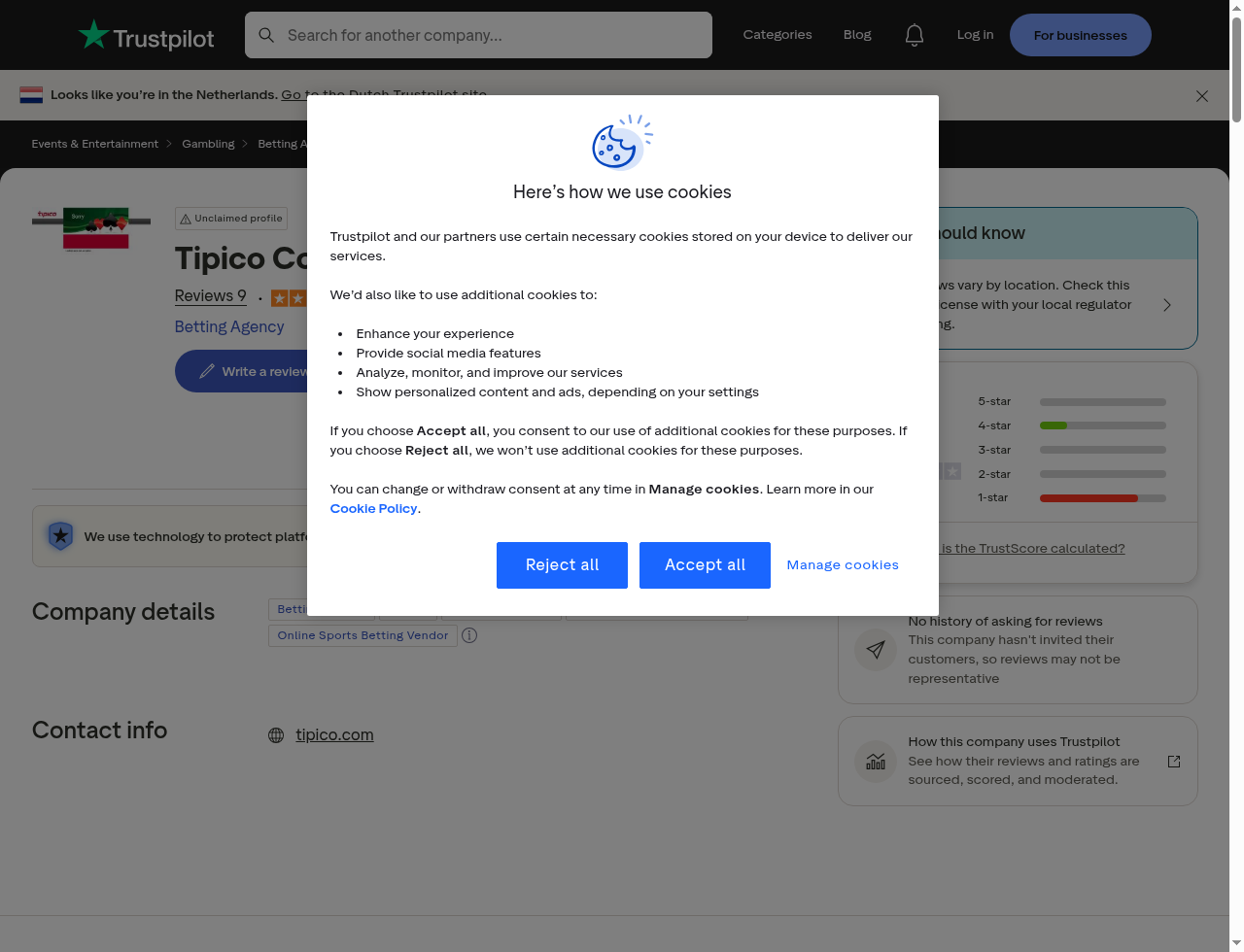
No individual review is used here to establish fraud, non-payment or regulatory breach. A recurring allegation could justify further document-led investigation, but repetition alone does not make it true. Primary records establish identity; authenticated correspondence and transaction records establish what happened in an account; a competent decision may establish whether rules were breached.
Evidence chronology, unknowns and method
The assessment uses source roles rather than combining every reference into one score. Primary regulator and legislative records carry the greatest weight for identity and legal framework. Public user material is retained only as context. No operator marketing claim was needed to reach the identity verdict.
| Date checked | Record | Supported conclusion |
|---|---|---|
| 21 August 2026 | MGA exact-address checker capture | The selected exact address returned the named current record. |
| 21 August 2026 | MGA licensee register | The regulator provides a live company and licence search facility. |
| 21 August 2026 | Malta Gaming Act, Chapter 583 | Malta has a statutory framework governing gaming. |
| 21 August 2026 | Public review profile capture | A dated profile existed; individual reports remain unverified context. |
Important unknowns remain: no licence expiry date was supplied; no account-access reason was verified; no KYC file was reviewed; no balance was independently confirmed; no payment method or withdrawal result was tested; and no competent complaint decision was included. None of those gaps should be filled with assumptions.
The methodology requires an exact address, company and licence match for a green identity signal. Red would require an official adverse record or corroborated documented evidence. Where identity evidence is missing or unresolved, amber is more appropriate. Further detail on these distinctions appears in the methodology and licence and law guidance.
Practical decision and correction path
The present evidence supports using the genuine service only after independently confirming the current regulator result. If the account is already locked, the immediate priority is documentation and written escalation—not another deposit, a duplicate account or payment to a supposed recovery agent. A person who understands the remaining limits and chooses to proceed can use the View the option once; the destination should still be checked before any credentials or funds are entered.
Corrections should identify the disputed sentence, provide a current primary record or authenticated account document, state the relevant date and explain whether the issue concerns the website address, company, licence or an individual account event. A public allegation without supporting records may be logged as context but cannot replace primary evidence. Material regulatory changes should trigger a new exact-address and register check rather than an unsupported edit.
Frequently asked questions
Is Tipico a scam or legitimate in Malta?
The current primary evidence supports a legitimate regulatory identity for tipico.com, Tipico Karlsruhe Ltd and licence MGA/CRP/972/2022. This green signal does not guarantee a particular withdrawal, account decision or complaint outcome.
Does a locked account mean the operator has taken the balance?
No. A restriction alone does not establish what happened to the balance. Preserve the ledger, restriction message, transaction records and support replies, then request a written explanation and the next verification or complaint step.
How can I check that I am using the genuine website?
Inspect the registered website address, enter the exact address in the MGA checker, and compare the returned company and licence with Tipico Karlsruhe Ltd and MGA/CRP/972/2022. Do not rely on a logo, advertisement or padlock alone.
Has a withdrawal test been completed?
No. The supplied evidence contains no independent deposit or withdrawal test, so payout speed, fees, limits, payment-method availability and the result of any individual withdrawal remain unknown.
What should I send for KYC?
Send only documents requested through an authenticated account or independently verified support route. Confirm the purpose, accepted format and secure upload channel, and never disclose a password, PIN, one-time code or complete card security code.
Where should an unresolved complaint go?
Use the service’s formal complaint route first, keep a dated chronology and request a final written response. If unresolved, check the current licence record and the regulator’s published escalation process without assuming that the regulator will decide in either party’s favour.