
PokerStars in Malta: licence record, payouts and bank reconciliation
A withdrawal that reads as processed in the cashier yet reaches the bank two days later, or arrives in two separate credits, is what pushes most players in Malta to ask whether PokerStars is a legitimate operation or a lookalike trading on the name. Treat it as a reconciliation question first. Every transfer carries a sender, a reference, a value date and a settlement route, and each can be checked without relying on anyone's assurance. On current primary records the licensing position of the exact hostname is clean, which makes a delay more likely to be a banking or verification artefact than proof of a vanished operator. Two layers stay apart below: what the regulator's own records confirm as of 21 August 2026, and what only your statement, cashier history and written correspondence can establish about one particular transfer.
When a payout lands late, or lands short

| Check | Recorded position | Checked on |
|---|---|---|
| Exact hostname | pokerstars.com | 2026-08-21 |
| Licensee | TSG Interactive Gaming Europe Limited | 2026-08-21 |
| Licence reference | MGA/B2C/213/2011 | 2026-08-21 |
| Licence expiry | Absent from the source ledger | — |
| Signal | Green, on current primary records | 2026-08-21 |
The reference numbers that make a payout traceable
Resolving a missing transfer means matching two records: what the cashier says it sent, and what the bank says it received. That match needs identifiers captured the same day, because withdrawal histories paginate and statement narratives get truncated. Capture the whole withdrawal entry rather than a cropped image of the amount, and note the timezone the timestamp is shown in. Where a payout was split, each part carries its own reference and value date, and treating them as one event is what turns a partial credit into an apparent shortfall. Record the requested amount, the credited amount and any conversion separately, since a gap between the first two is often a spread rather than a deduction. Your bank cannot search on a brand; it searches a reference, an amount and a date range.
| Field to capture | Where it comes from | Why it settles the argument |
|---|---|---|
| Cashier transaction identifier | Withdrawal history entry | Ties the claim to one event the operator can locate |
| Timestamp and timezone | Same entry and account settings | Separates a same-day delay from a multi-day one |
| Requested and credited amounts | Cashier entry and statement line | Distinguishes a conversion spread from a deduction |
| End-to-end or scheme reference | Statement detail view | The only field a bank can search on |
| Value date | Statement line | Fixes when funds actually became available |
| Destination account, last four digits | Cashier payout destination | Rules out a credit sent to a stale method |
Who the counterparty actually is
The company on the other side of the agreement is TSG Interactive Gaming Europe Limited, the licensee recorded against licence reference MGA/B2C/213/2011. That distinction decides how a dispute travels, because bank investigators and regulators work from a legal entity and a licence number rather than a name in a page header. The regulator publishes a live licensee register where the entity and the status of its licence can be read directly, and that entry is what to quote when a bank asks who initiated a credit. Registered address, company registration number and licence expiry were absent from the source ledger, so none is stated here: request them in writing, or read them from the register entry, and keep the reply on file. Where the account terms name a different company altogether, treat it as a hostname problem rather than untidy paperwork.
Licence status checked against the exact hostname
Malta's regulator operates an address-level tool, so licensing can be tested against a hostname instead of a brand. Queried on 21 August 2026, the exact-address checker returned a current record for pokerstars.com naming the licensee above under MGA/B2C/213/2011. That single fact is the entire basis for the green signal, and it is deliberately narrow: one hostname on one date, not every mirror, application build or promotional landing page reusing the same artwork. Re-run the query before a first deposit and before any unusually large cash-out, since a licence record describes a live status rather than a permanent attribute. No expiry date appeared in the ledger, so the term of the licence is unverified and re-checking is the only way to keep the position current.
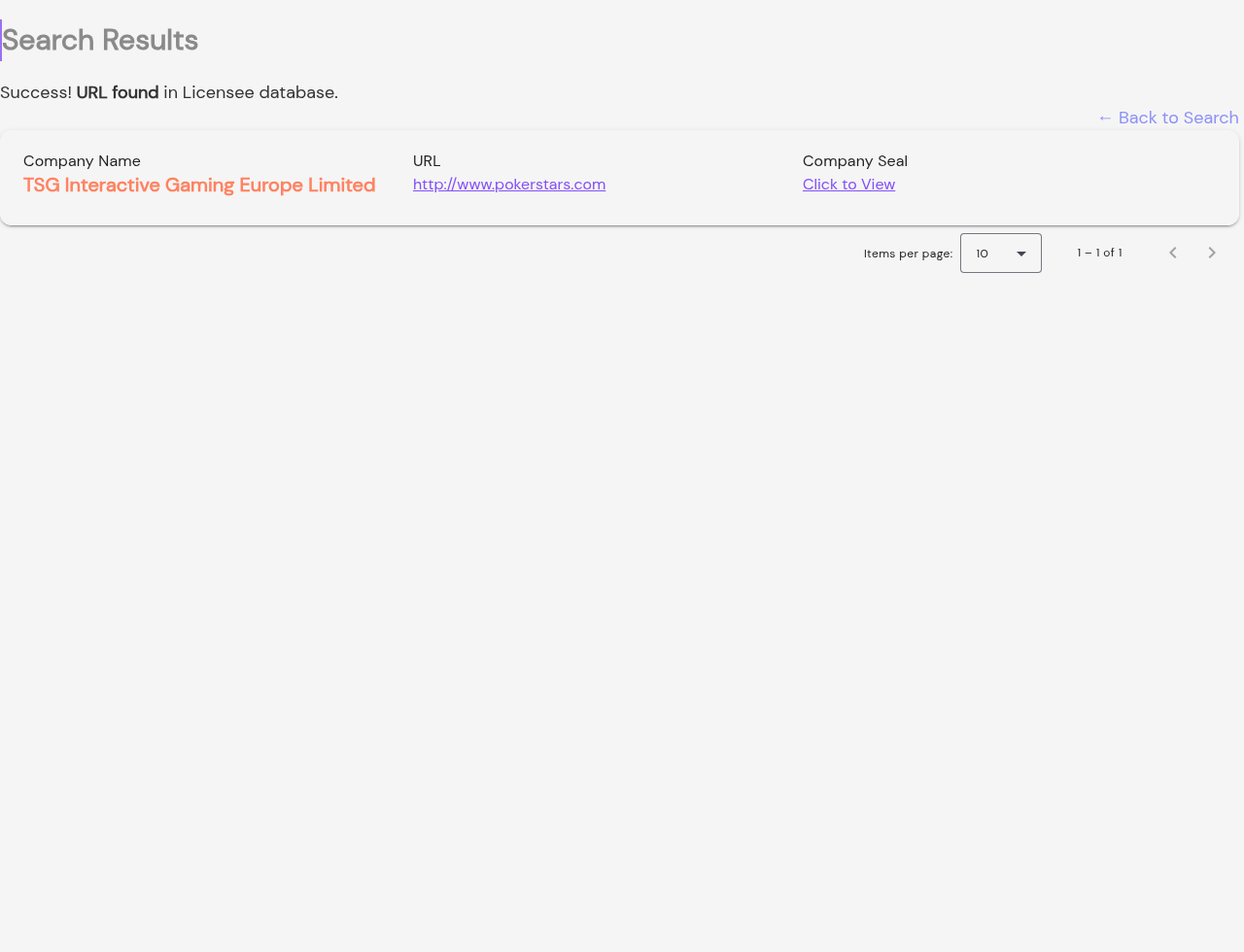
With hostname, licensee and licence reference in agreement, you can View the option and set a deposit limit before the first transfer; the tools worth setting first are covered in our responsible gambling notes.
What the payment route does to reconciliation
No method list, fee schedule or processing-time table was supplied for the operator, so none is reproduced: read the cashier's own list before committing funds. What travels regardless is how route families behave once a credit has to be traced, which lets you classify whatever the account offers. The general rule is that the more intermediaries sit between the operator's payment provider and your bank, the more references exist and the more places a transfer can rest with nobody acting on it. Ask which provider actually executes payouts, because that is the entity your bank will see, and it may bear no resemblance to the brand you played on. Route families and the identifiers each one produces are collected in our payments notes.
| Route family | Typical trace on a statement | Identifier to quote | Reconciliation friction |
|---|---|---|---|
| Card | Merchant descriptor and scheme reference | Acquirer reference or authorisation code | Returns follow the original card, so a replaced card stalls the credit |
| Bank transfer | Sender name and remittance narrative | End-to-end reference | Value dates skip weekends and public holidays |
| Wallet or intermediary | Two hops, each dated separately | One reference per hop | The second hop sits outside the operator's control and needs its own request |
Withdrawal holds, partial credits and what to log
No withdrawal test exists for the operator, so no timing claim is made in either direction. The sequence, though, is portable: a request moves from pending, to approved by the operator, to sent to the payment provider, to settled at your bank, and only the final step appears on a statement. Log the status you see at each stage with a time and date, because a hold placed at approval sits with the operator while a delay after sending sits in the banking chain, and the two escalate to different places. If a status has not moved for a full working day, ask which stage it is sitting at and who holds it. Keep the cashier's stated limits beside that log: a per-transfer ceiling explains split credits more often than any dispute does, and it is a figure you can verify yourself.
Verification checkpoints that can stop a transfer mid-flight
Licensed operations in Malta carry statutory duties on identification, anti-money-laundering monitoring and player protection, so a document request interrupting a cash-out is a normal feature of a regulated cashier rather than evasion in itself. Which documents this account will be asked for was not part of the verified evidence, so no list is given. Handling still matters: upload through the in-account facility rather than email where both exist, so the submission carries a timestamp that cannot be mislaid; expect the receiving account to be in your own name, since third-party payouts are generally refused; and if a request repeats after a successful upload, ask which specific field failed instead of sending the same file again.
Escalating to your bank without breaking the audit trail
Bank escalation works when it follows the operator rather than replacing it. A trace is a factual question about whether funds reached your institution; a recall applies to money you sent; a chargeback disputes a card payment you made. Winnings owed are none of the three, which is why a written processing confirmation has to come first. Ask your bank to record the query in writing too, since a verbal 'nothing received' cannot be produced later. Disputing a gambling deposit by chargeback may also end the account relationship, so it belongs at the end of the ladder rather than the start. Keep every step in one dated file, because each participant will ask what the previous one said.
| Step | Who acts | What to supply | What it can achieve |
|---|---|---|---|
| Written claim to the operator | You | Transaction identifier, date, amount, destination | A processing date and reference to hand onward |
| Payment trace | Your bank | Reference, amount, date range | Confirms whether funds reached the institution |
| Recall or return | Sending institution | Original reference | Applies to money you sent, not to winnings owed |
| Card chargeback | Card issuer | Deposit reference and correspondence | Deposit disputes only; may close the account |
| Regulatory complaint | You | Dated log of the steps above | Independent review of how the licensee handled it |
Ruling out copycat hostnames
A cloned page will accept your login without complaint, so the address is the first check rather than the last. Compare the string character by character against pokerstars.com, and treat an added word, hyphen, doubled letter or unfamiliar ending as a different site until the regulator's tool says otherwise. Confirm the certificate is issued to the domain you meant to reach, and check that any mobile download names the licensee as publisher rather than an unrelated developer. Reach the cashier by typing the address or using your own bookmark, never from a message announcing a payment problem, because that pretext is exactly what a copy needs. Bookmark the address once it has passed the checker, and re-verify after any redirect you did not initiate. An address that fails the check, or returns a record for another entity, is a reason to stop and report rather than deposit.
Complaint route and the legal frame in Malta
Play offered from Malta sits under Chapter 583, the Gaming Act, which sets the statutory framework and the regulator's supervisory role. A complaint then follows an order: a written claim to the operator quoting the transaction reference and a date by which you expect an answer, the regulator once the operator's process has replied or lapsed, and your bank for anything concerning the movement of funds. Keep that sequence dated, because a claim unable to show what was asked and when tends to stall at the first request for evidence. How allegations are weighed, and what turns one into a finding, is set out in our complaints and warnings notes, while licence and law covers what a register entry does and does not prove.
Risks, unknowns and how corrections are handled
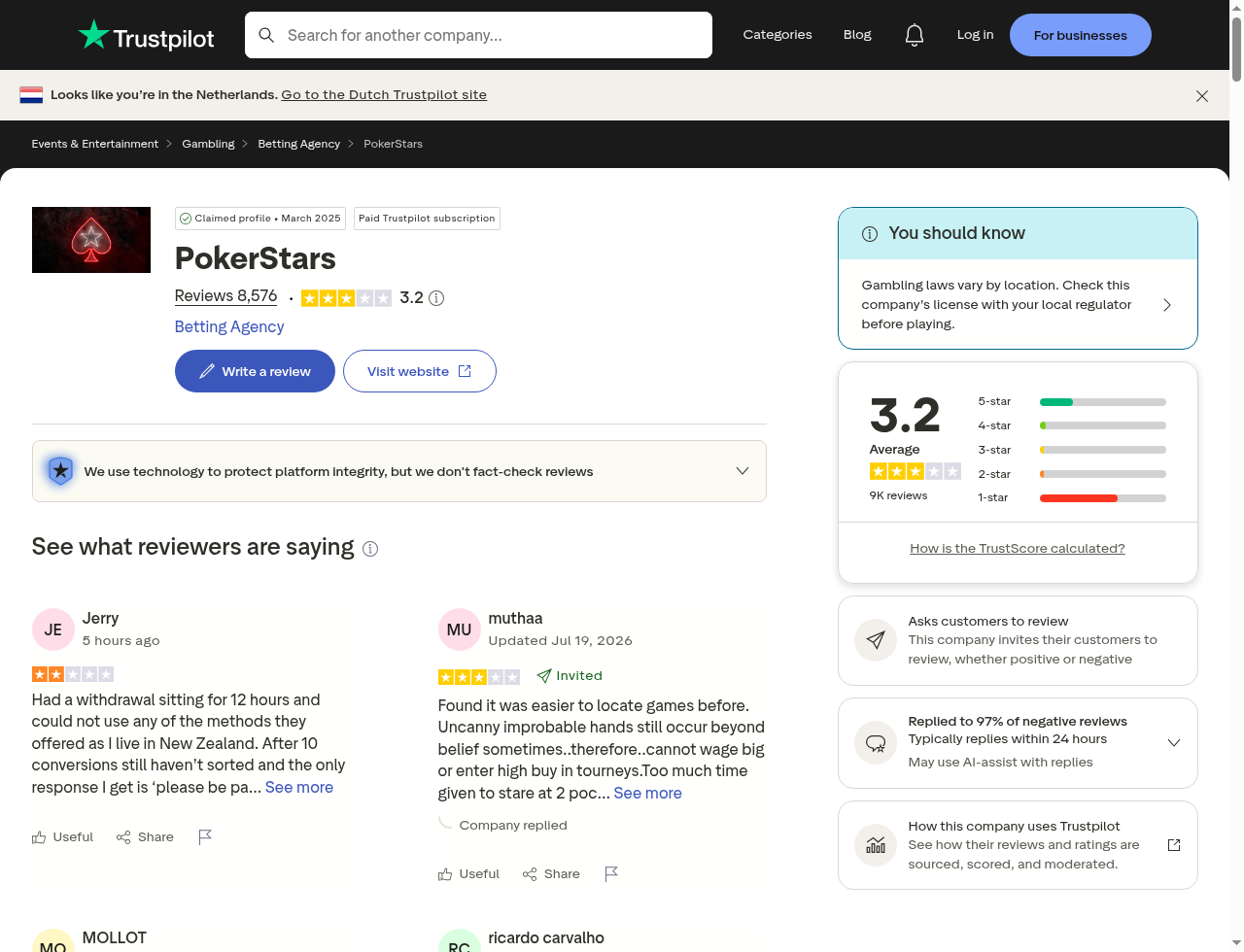
Three things remain open. The expiry date of the licence is unknown, so continuity beyond the check date is not asserted. No payment or payout timing evidence exists for the operator, which makes any statement about speed invention. And user commentary about payments, including the dated public review profile captured below, stays unverified context: an allegation becomes a finding only when a competent authority publishes a dated adverse record, and none is recorded as of 21 August 2026. The evidence supporting the green signal is listed in full so it can be re-tested independently. Our methodology explains how the tiers are kept apart, and contact is the route for a correction: send the record, its date and its origin, and a dated amendment follows if the position has moved.
| Source | Tier | What it establishes | Checked on |
|---|---|---|---|
| MGA-CHECKER | Primary | The current record returned for the queried exact address | 2026-08-21 |
| MGA-REGISTER | Primary | A live licensee register and address checker are published | 2026-08-21 |
| LAW-583 | Primary | Chapter 583 establishes Malta's statutory gaming framework | 2026-08-21 |
| CTX-POKERSTARS | User context | A dated public review profile exists; entries are unverified | 2026-08-21 |
Common questions
Is PokerStars legal to play from Malta?
On the records checked on 21 August 2026, the exact address pokerstars.com returns a current Maltese licence record naming TSG Interactive Gaming Europe Limited under MGA/B2C/213/2011, and the Gaming Act supplies the statutory framework for licensed play. That covers one address on one date. Re-run the query before depositing, because a licence is a live status.
Which company do I actually have a contract with?
TSG Interactive Gaming Europe Limited, the licensee recorded against MGA/B2C/213/2011. Quote that name and reference when writing to a bank or filing a complaint, since neither works from a brand name. Registered address, company number and licence expiry were absent from the source ledger and are not stated.
Why would a withdrawal arrive as two separate credits?
Split credits usually reflect batching or a per-transfer ceiling somewhere in the chain, and each part carries its own reference and value date. Add the credited amounts together before assuming a shortfall, then compare the total with the requested amount and any conversion. No withdrawal test was carried out, so no timing expectation is asserted.
Does a poor public review score prove that money is withheld?
No. A dated public review profile exists for the brand, but individual entries are unverified accounts held as context. An allegation becomes a finding only when a competent authority publishes a dated adverse record, and none is recorded as of 21 August 2026.
How do I tell a copied site from the licensed one?
Compare the address character by character with pokerstars.com, ignoring nothing: an extra word, a hyphen or an unfamiliar ending makes it another site. Then run that exact address through the regulator's checker rather than trusting a page's own claims, and reach the cashier by typing the address yourself.
What should I include when escalating a missing payout?
The cashier transaction identifier, the date and timezone, the requested and credited amounts, the last four digits of the destination account, any bank reference for the credit, and a dated list of every message already sent. Keep it factual and chronological, because an escalation is judged on whether the timeline can be verified.