
Casumo Malta evidence dossier: licence, terms and disputes
The decisive starting point in a bonus dispute is the version of the terms accepted when the promotion was claimed. A current licence record can establish who is authorised for a domain, but it cannot by itself prove what a particular bonus promised, whether wagering was completed, or why a withdrawal was delayed. Preserve the dated offer, full terms, account ledger and correspondence before arguing the merits.
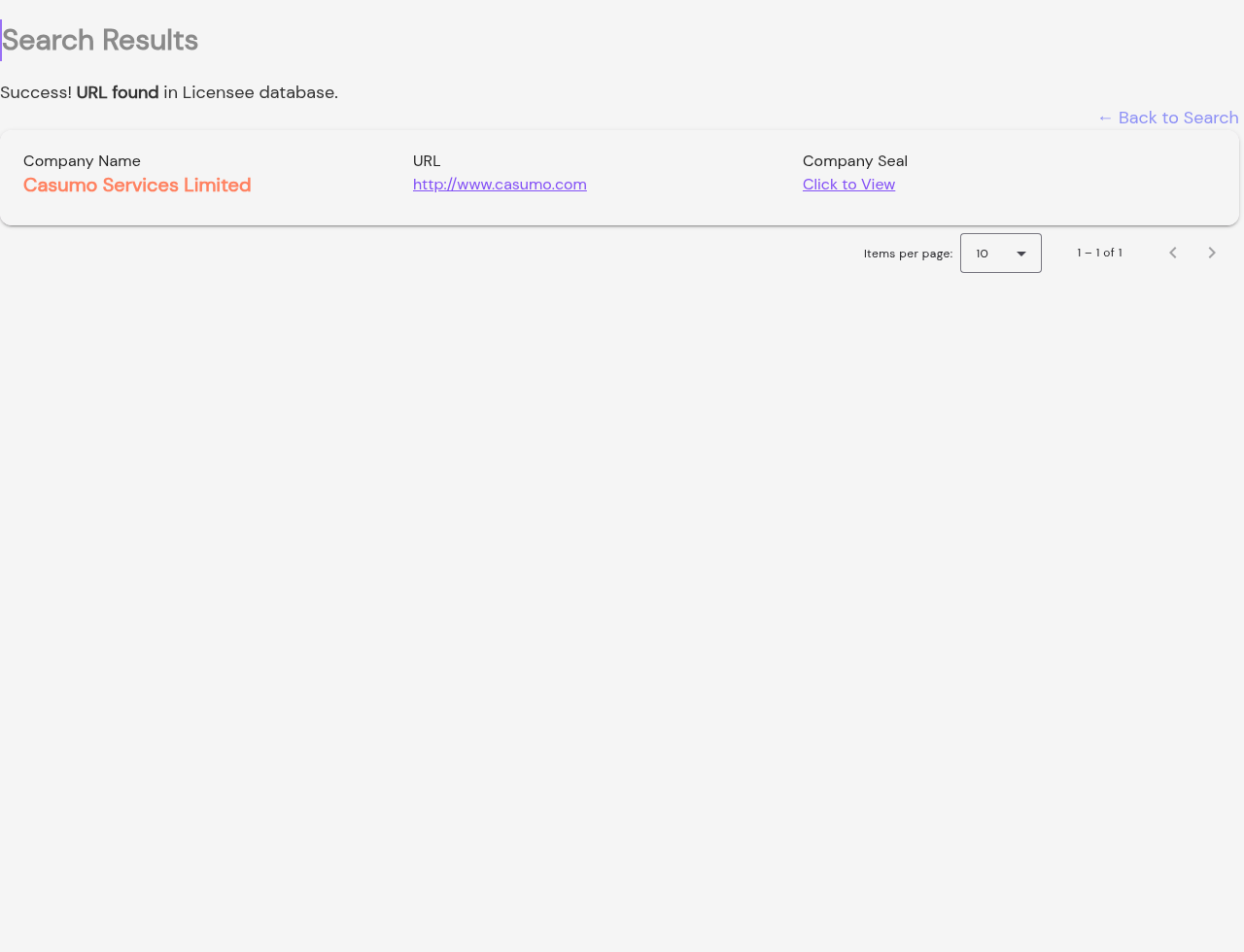
The evidence checked on 21 August 2026 supports a match between casumo.com, Casumo Services Limited and licence MGA/CRP/217/2012-05. That current primary record supports a green identity-and-licensing signal for the precise domain. It is not a blanket endorsement of every transaction, promotion or complaint outcome.
Verdict at a glance
| Question | Finding | Evidential limit |
|---|---|---|
| Does the checked domain match an MGA record? | Yes. The exact-domain check returned the supplied current record for casumo.com. | The capture records the result on 21 August 2026; status should be checked again before depositing. |
| Which entity is named? | Casumo Services Limited. | This identifies the supplied licensed entity, not an unrelated lookalike or differently spelled domain. |
| Which licence is supplied? | MGA/CRP/217/2012-05. | No expiry date was supplied, so none is claimed. |
| Is it a scam or legitimate in Malta? | Current primary evidence supports legitimacy for the exact domain and named entity. | Licensing does not settle an individual bonus, payment or withdrawal dispute. |
| Are payment speed and withdrawal performance proven? | No. | No transaction test, processing-time record or supported payment-method list was supplied. |
The appropriate signal is green for the domain, entity and current primary licence match. It must not be stretched into a claim that withdrawals are always fast, bonuses are always favourable, or complaints are always resolved correctly. Those propositions require separate transaction-level evidence.

Exact domain, operator and licence match
The identity chain has three parts: the address entered in the browser, the legal entity shown by the regulatory result, and the licence number attached to that record. Here, the supplied chain is casumo.com → Casumo Services Limited → MGA/CRP/217/2012-05. The captured query was checked on 21 August 2026 and is classified as primary evidence.
A player should repeat the exact-address check rather than searching only for a familiar name. The MGA exact-URL checker is designed for this purpose. Enter the complete address being used and compare the returned entity and licence with the details above. A result for the correct spelling does not validate another suffix, an added word, a subdomain controlled by somebody else, or a link received through an unsolicited message.
The MGA licensee register provides the complementary entity-level check. Search for Casumo Services Limited and compare the record rather than relying on a badge displayed by a gambling service. Regulatory records are stronger evidence than copied seals, advertisements or screenshots circulated without a verifiable date.
| Identity element | Verified value | What the player should compare |
|---|---|---|
| Domain | casumo.com | Exact spelling, suffix and browser address |
| Legal entity | Casumo Services Limited | Name in the regulator result and contractual terms |
| Licence | MGA/CRP/217/2012-05 | Complete number, including suffix |
| Primary check date | 21 August 2026 | Recheck if playing later or after a redirect |
What the green signal does and does not establish
The green signal answers a narrow but important question: current primary evidence supports the precise domain, entity and licence combination supplied for this dossier. It reduces the uncertainty that would exist if only promotional claims, a logo or public comments were available. It also supports the conclusion that the service is not an anonymous imitation when reached through the verified address.
It does not prove that every promotional term is fair, that every game session is error-free, or that a particular balance must be paid. A regulator entry cannot reveal whether a player met wagering conditions, used an excluded game, exceeded a maximum stake, supplied acceptable identity documents, requested a payment to an eligible account, or triggered a security review. Those questions depend on the accepted contract and dated account evidence.
Malta’s statutory framework is set by the Gaming Act, Chapter 583. That establishes the legal setting in which the licence evidence is assessed. The supplied packet does not establish the player’s location at the time of play, tax position, age, account eligibility or compliance with any jurisdiction outside Malta. Legality should therefore be understood as a supported Malta licensing conclusion for the identified service, not universal permission to gamble from every country.
Players should also distinguish regulatory status from personal suitability. Even a licensed service can be unsuitable for someone experiencing loss of control, chasing losses or borrowing to gamble. Practical safeguards and support routes are available under responsible gambling, independently of the licensing verdict.
Bonus terms and transaction chronology
A bonus dispute should be reconstructed from the moment the offer was presented. The most useful record is the exact version of the promotional terms accepted at that time, not a later summary or a recollection of an advertisement. Save the offer heading, eligibility rules, minimum deposit, wagering multiplier, qualifying games, excluded games, maximum stake, time limit, withdrawal restrictions and any maximum conversion rule actually shown.
No specific bonus conditions were supplied in the evidence packet, so none are attributed to the operator here. There is also no supported account history showing that a bonus was claimed, cancelled, completed or confiscated. The following chronology is therefore a documentation framework rather than a finding about an actual dispute.
| Stage | Record to preserve | Why it matters |
|---|---|---|
| Offer presentation | Dated capture of the offer and full terms | Establishes the wording available before acceptance |
| Deposit | Receipt, amount, currency and transaction reference | Connects the promotion to the funding event |
| Bonus activation | Account entry and activation time | Shows whether the promotion was actually applied |
| Play | Game history, stake sizes and timestamps | Tests compliance with game and stake restrictions |
| Wagering progress | Ledger before and after each relevant session | Helps identify how progress was calculated |
| Withdrawal request | Amount, method, timestamp and status | Fixes the point at which payment was requested |
| Operator decision | Complete message with stated clause and reason | Allows the reason to be tested against accepted terms |
Build a single timeline in chronological order. Keep original files and exportable records where available; avoid editing captures in a way that removes timestamps or addresses. If the operator cites a clause, ask which dated version applied and how the account events allegedly breached it. A useful complaint identifies the disputed amount, the exact decision, the relevant clause and the remedy sought.
Payments, withdrawals and identity checks
The supplied evidence does not verify any particular deposit method, withdrawal rail, fee, minimum amount, currency-conversion rate or processing time. It also contains no controlled deposit-and-withdrawal test. Claims that a method is available or that payment takes a certain number of hours would therefore be unsupported. Check the account interface and applicable terms at the time of the transaction, then preserve what is displayed.
Identity verification, often abbreviated as KYC, may involve checks relating to identity, age, address, payment ownership or source of funds. However, no operator-specific document list, threshold or review timetable was supplied. Do not assume that one document will be sufficient or that an advertised withdrawal estimate includes verification time. Request a written list of what is required, the reason for each request, the accepted file format and whether any existing submission was rejected.
| Issue | Supported finding | Sensible evidence to retain |
|---|---|---|
| Deposit methods | Unknown from this packet | Method screen, fees, limits and receipt |
| Withdrawal methods | Unknown from this packet | Available choices, destination and request confirmation |
| Processing speed | Not tested | Submission time and each status change |
| Verification documents | No specific list supplied | Request, upload confirmation and response |
| Source-of-funds review | No case evidence supplied | Questions asked and documents provided |
| Failed or reversed payment | No incident established | Bank or wallet reference and operator explanation |
Before depositing, compare the account-holder name with the payment instrument and note any displayed withdrawal conditions. For a delayed withdrawal, separate the stages: requested, pending, verification requested, approved, sent and received. “Pending” alone does not identify the cause. Ask for the current stage, any missing action, and a case reference. Broader payment-risk guidance is available under payments.
Complaint evidence and escalation route
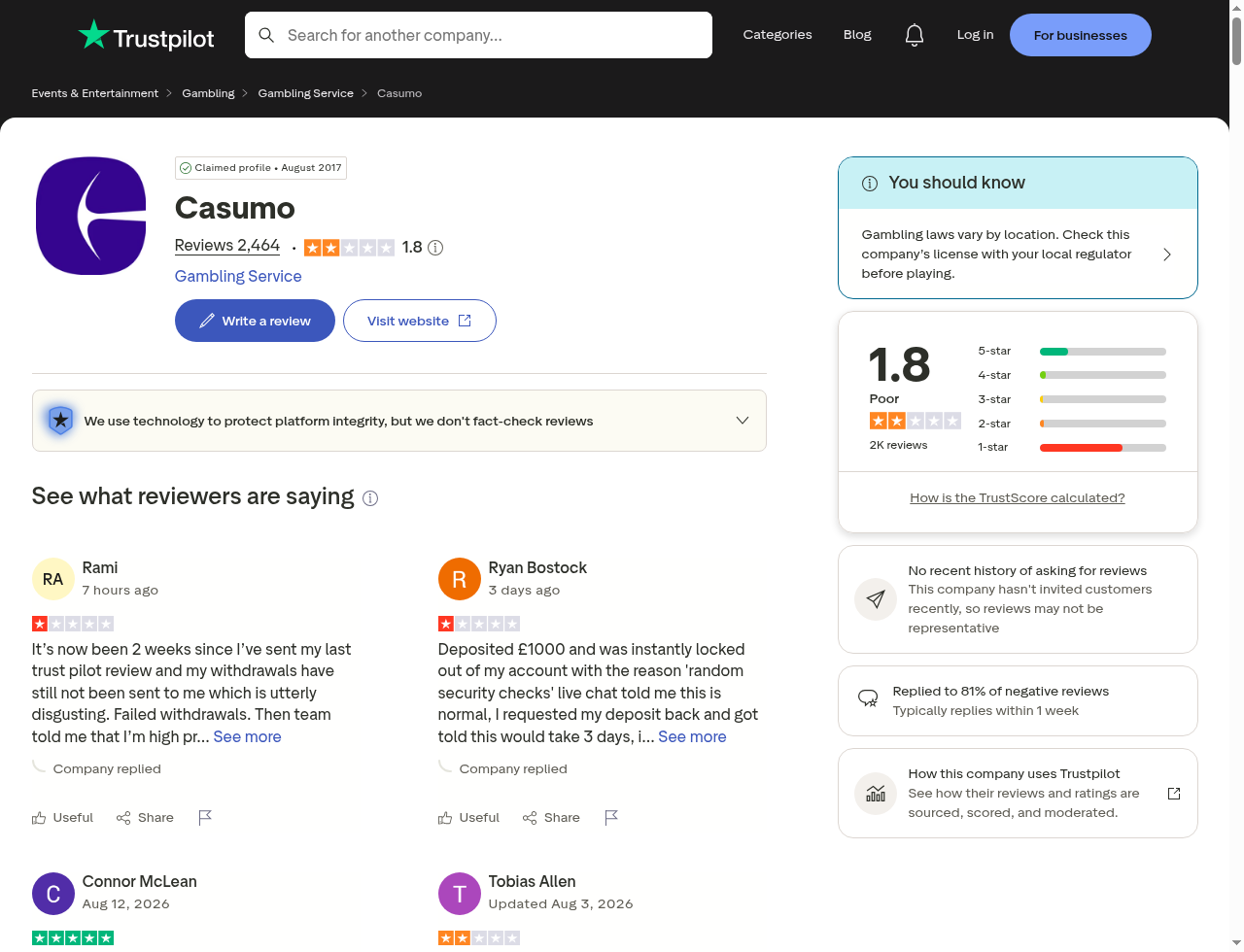
The public review profile supplied in the packet confirms that dated user commentary exists. Individual posts remain unverified context. They cannot establish that a described event occurred, that the writer held an account, that all relevant correspondence was disclosed, or that the operator was at fault. Review volume, star ratings and isolated narratives are not substitutes for a transaction ledger or a competent decision.
Start with the operator’s documented complaint process shown in the applicable terms or account support area. State the account identifier without publishing it publicly, the disputed transaction, dates, amount, clause relied upon, prior case references and requested remedy. Ask for a final written response. Keep the full conversation, not selected excerpts.
If internal handling does not resolve the matter, identify the escalation route stated in the accepted terms and verify it independently against current official information. The supplied packet does not name an alternative dispute-resolution body or establish that a particular complaint qualifies for regulatory intervention, so no such destination is invented. Guidance on organising a case is available under complaints and warnings, while documentary corrections can be sent through contact.
Clone and impersonation checks
A copied logo or familiar colour scheme proves nothing about control of a web address. Begin every session by checking the browser address character by character. Watch for extra words, substituted letters, unexpected suffixes and addresses embedded in longer misleading names. A secure connection only encrypts traffic to the address shown; it does not establish that the recipient is the licensed entity.
Repeat the regulator query if a message sends you to a different address, if the service redirects unexpectedly, or if payment instructions change. Compare the entity and complete licence number, not merely the name. Do not treat the supplied logo as regulatory evidence. The decisive record is the result associated with the exact address.
Unsolicited requests for passwords, one-time codes, remote-access installation, cryptocurrency transfers or payment to a personal account should be treated as warning signs. These examples are general anti-impersonation precautions; the packet does not allege that the licensed operator engaged in them. Stop and verify through a separately located support route rather than replying to the original message.
For readers who have independently repeated the address and licence checks, the single commercial route supplied for this dossier is View the option. It should not be used when the browser address differs from casumo.com or when identity remains uncertain.
Remaining risks and unknowns
The packet leaves material transaction questions open. There is no withdrawal test, no supported list of payment methods, no processing-time sample, no KYC case, no bonus ledger and no competent decision on a complaint. There is also no supplied licence-expiry date, so an expiry date must not be guessed. A current check should always be repeated when timing matters.
The principal evidenced strength is regulatory identity: the exact domain is connected to the named entity and licence in current primary material. The principal limitation is that regulatory identity does not answer account-specific questions. A player facing a dispute still needs the accepted terms, account history, payment records and complete correspondence.
| Risk or unknown | Current status | Effect on the verdict |
|---|---|---|
| Domain impersonation | Address must be checked each time | Green applies only to the exact verified domain |
| Bonus interpretation | No case or terms version supplied | No conclusion on any individual bonus dispute |
| Withdrawal reliability | No controlled test supplied | No speed or success claim |
| KYC handling | No account-level evidence supplied | No conclusion on document demands or timing |
| User complaints | Context exists but is unverified | Does not change the primary licensing signal |
| Future regulatory status | Cannot be guaranteed | Recheck the official record before relying on it |
A green licence signal should therefore be read as “current identity supported,” not “risk-free.” Gambling involves financial loss, and no regulatory record changes that. Anyone experiencing urgent harm should use urgent help rather than continuing to play or attempting to recover losses through further gambling.
Evidence chronology, method and corrections
The evidence date is 21 August 2026. On that date, the primary packet included the exact-domain checker result and the availability of the MGA licensee register. The legal framework source was Chapter 583 of the Laws of Malta. The user-comment capture was retained only to show the existence of public context and was not used to prove individual allegations.
The method gives greatest weight to current primary records that identify the exact domain and entity. Operator assertions would be labelled separately if supplied; none are relied upon for payment speed, bonus fairness or withdrawal performance. User reports remain contextual unless corroborated by documentary evidence or a competent determination. Unknowns stay unknown rather than being filled with assumptions. The full editorial approach is described under methodology.
Corrections should include the disputed statement, a current primary record or complete documentary trail, the relevant date and an explanation of what changed. A later regulator result may justify revising the signal. A transaction complaint may justify adding carefully attributed context, but it does not automatically overturn the domain-level licence finding. Personal information, account numbers and identity documents should not be submitted through a public comment or published as proof.
Frequently asked questions
Is Casumo a scam or legitimate in Malta?
Current primary evidence checked on 21 August 2026 supports `casumo.com` as associated with Casumo Services Limited and licence MGA/CRP/217/2012-05. That supports a legitimate-domain finding in Malta, but it does not prove the outcome of any individual bonus, withdrawal or complaint.
Is casumo.com the domain covered by the evidence?
Yes. The supplied exact-domain capture concerns `casumo.com`. Similar spellings, added words, other suffixes and unexpected redirects are not covered. Enter the complete address into the MGA checker and compare the returned entity and licence.
Does the MGA record guarantee that every withdrawal will be paid quickly?
No. The record supports regulatory identity, not a particular processing time or transaction outcome. No controlled withdrawal test or supported processing-time data was supplied. Preserve the request time, status changes, verification messages and payment references.
Which payment methods and KYC documents are required?
The evidence packet does not establish a payment-method list or an operator-specific document checklist. Check the current account information and applicable terms, then retain the displayed limits, fees and verification requests. Do not infer availability from another market or an old promotion.
How should a bonus dispute be documented?
Save the dated offer, complete accepted terms, deposit receipt, activation record, game and stake history, wagering ledger, withdrawal request and the operator’s full decision. Present them chronologically, identify the clause in dispute and state the precise remedy requested.
Do public reviews prove a complaint?
No. The supplied capture establishes that a public review profile exists, but individual comments are unverified context. A complaint becomes materially stronger when supported by account records, complete correspondence and, where available, a decision from a competent body.