
bwin in Malta: licence match, name checks and payout evidence
A payout rarely stalls because an operator turns out to be fraudulent. It stalls because two names disagree: the one printed on an identity document and the one attached to the account or the instrument behind it. For bwin.com, the accepted record settles ownership and licensing as at 21 August 2026. What it does not settle is how document reviews run in practice, so the checks that matter are the ones a Maltese player controls before a first deposit rather than after a held withdrawal.
Where a name mismatch actually stops a payout
Three names have to agree before money leaves a licensed cashier: the name on your identity document, the name registered on the account, and the name on the instrument that funded it. Deposits usually clear without that comparison being made. Withdrawals are where it is made, which is why an account can behave normally for weeks and then stall at the first cash-out.
Maltese paperwork brings its own friction. Double-barrelled surnames, a maiden name still printed on a bank card, an anglicised first name typed at sign-up, or an identity card carrying diacritics a keyboard dropped are ordinary causes of a mismatch, and none implies bad faith on either side. Register exactly as the document reads, character for character, and hold that spelling across every method you intend to use. The accepted record carries no documented verification timeline, so your own paperwork is the only variable genuinely in your hands.
The address, operator and licence on record

A brand name is not a licence and a mark is not a record, so identity comes first. The lines below are what the exact-address query returned on the check date, and each covers that single address only.
| Item | On the accepted record | Basis |
|---|---|---|
| Exact address checked | bwin.com | Exact-address query, 21 August 2026 |
| Licensed entity | bwin Holdings (Malta) Limited | Licensee record returned for that address |
| Licence reference | MGA/CRP/688/2019 | Licensee record returned for that address |
| Licence expiry | Not supplied | Held as unknown |
| Signal | Green | Current primary record for the precise address |
| Source tiers used | Regulator checker, licensee register, Gaming Act | Primary |
Expiry stays marked unknown rather than estimated. Anything absent from those lines was not verified, and an absent finding is not a clean finding.
Legal or not in Malta: what the framework settles
Malta's statutory basis for gaming sits in Chapter 583, the Gaming Act, which is what gives a licence reference legal weight rather than decorative value: the consolidated text of Chapter 583. Licensed status is not a badge in a footer either; it is a live entry the authority maintains in the MGA licensee register.
Two consequences follow for a player here. A licence belongs to a legal entity and to the addresses that entity has notified, so bwin Holdings (Malta) Limited sitting on the record does not automatically extend cover to every address showing the same brand. And the register outranks marketing copy or terms wording: where they disagree the register decides, and a dated capture of it is what a regulator or a payment provider will actually read. Wider background sits under licence and law.
Check the address yourself, and rule out lookalikes
Copy the address from your own browser bar rather than from an advert, a push message or an email, then type bwin.com into the MGA URL checker and compare the licensee name returned against the entity on record. Save the result with the date visible; a capture taken months later says nothing about the night an account was opened.
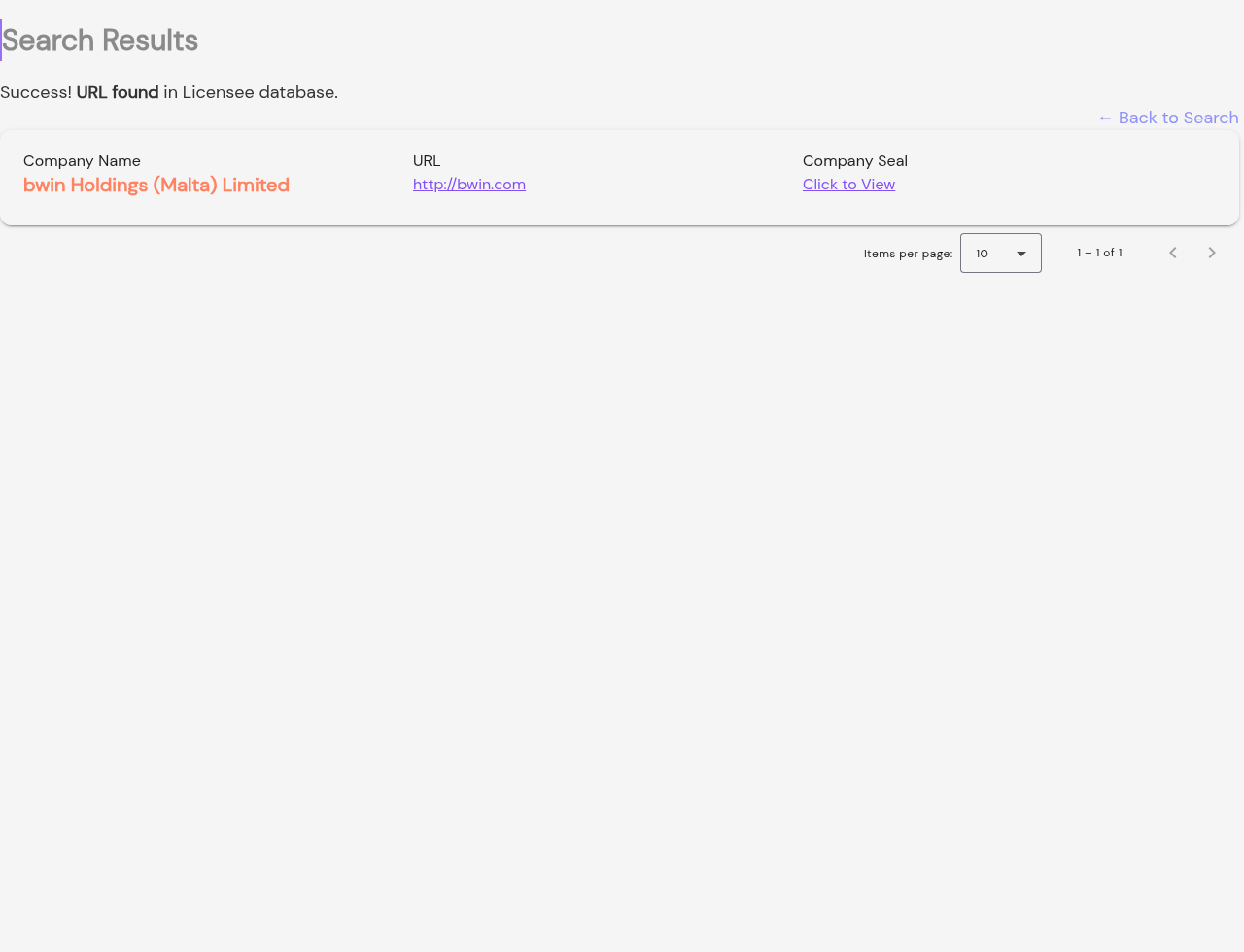
Lookalikes rely on small edits: an extra word before the extension, a swapped country extension, a hyphen pushed into the brand string, a subdomain that parks a familiar name in front of an unrelated registered domain, or Unicode characters that render like Latin ones. Redirects matter too, because the address you land on is the one the register either covers or does not. If the tool returns nothing for an address you were sent, treat it as uncovered until the register says otherwise.
Once the checker returns the licensed record for the address in your own browser bar, View the option rather than from a link in a message or an advert.
Account ownership: one person, one name
An account is a single named relationship. One person registers it, one identity document supports it, and instruments in that same name fund it. Opening a second account while the first is under review adds a duplicate-account problem to the original one, and letting a partner cover a deposit once introduces a payment name that cannot be reconciled with your document.
The practical version: register under your legal name, verify before the balance grows, and note which instrument funded which deposit. Where a shared card or a company account is involved, resolve that before playing rather than at cash-out. Anyone feeling pressure to keep an account funded should start with responsible gambling, well before payment questions matter.
Payment-name checks before the first deposit
Instrument names are compared with the account name, not with each other, so one verified name across every method is the safe pattern. Cashier options were not part of the accepted record, so method families are treated generically and coverage is marked honestly; market-level mechanics sit under payments.
| Instrument family | Name that must match | Capture before depositing | On the accepted record? |
|---|---|---|---|
| Debit or credit card | Cardholder name as printed | Banking-app profile name | No |
| Bank or SEPA transfer | Account holder on the IBAN | Statement header with name and IBAN | No |
| E-wallet | Verified name on the wallet | Wallet profile showing verified status | No |
| Prepaid voucher or code | None is attached | Receipt and serial, plus a named payout route | No |
| Joint or relative's instrument | Cannot match | Not usable | No |
Funding with a nameless instrument and cashing out to a named one is a routine source of delay, so decide the payout route before the deposit.
Withdrawals, document requests and what the record leaves open
Separating settled facts from gaps is the whole job of a document-led review. Licensing and legal identity are settled for the queried address. Timing, limits, fees and document lists are not, because no payout test forms part of the accepted record and nothing may be inferred to fill the space.
| Question | Status on 21 August 2026 | Practical step |
|---|---|---|
| Current licence over the exact address | Confirmed, primary record | Re-query before a new deposit run |
| Responsible legal entity | Confirmed, named Malta company | Use the legal name in writing |
| Withdrawal processing time | Not documented, no payout test | Log request and completion times yourself |
| Cash-out minimums and maximums | Not documented | Read and capture the cashier first |
| Required verification documents | Not documented | Prepare identity, address and payment proof anyway |
| Source-of-funds triggers | Not documented | Keep salary or transfer evidence retrievable |
| Fees and conversion | Not documented | Compare debited sums with your statement |
| Bonus terms affecting a payout | Not documented | Capture offer terms at opt-in |
Every unresolved row is a question to settle inside the cashier, in writing, before money moves.
Scam or legit: what a green signal does and does not mean
Green carries one precise meaning: on the check date, primary records tied the queried address to a named Maltese licensee and a current licence reference, and no official adverse entry appeared. It is not a service guarantee, a payout promise, or a statement about how any individual case was handled.
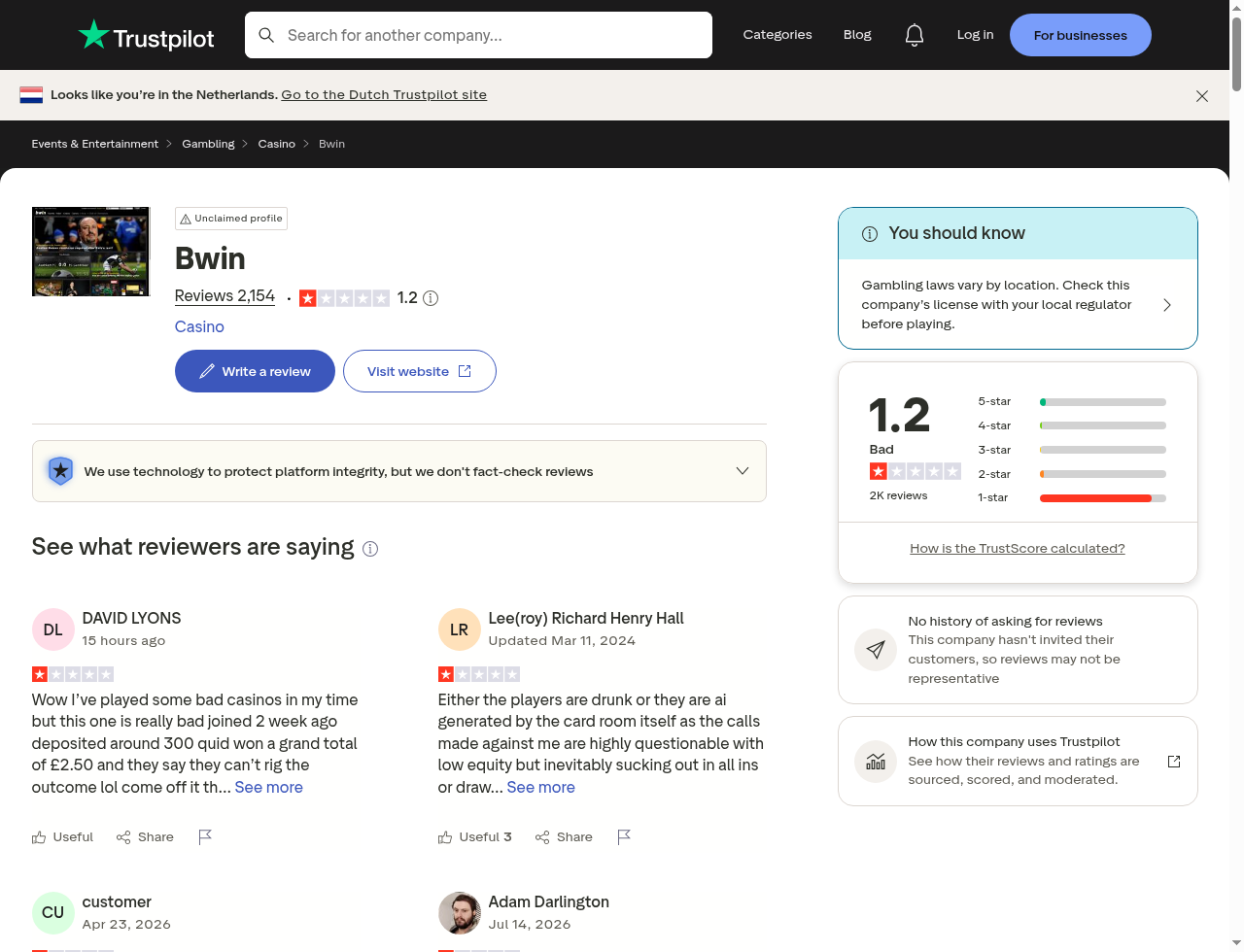
That profile exists and is dated, and it stays in the context tier. Individual entries are allegations: unverified, unadjudicated, usually missing the other side of the file. An allegation becomes an established fact when a competent authority issues a dated record, and none is present. Findings that clear that bar are collected under complaints and warnings, while address-level checks on other Malta-facing brands sit under casinos.
A complaint packet worth filing
Complaints fail on evidence, not on tone. A packet naming the licensed entity, quoting the licence reference and showing dated captures reads very differently from a message describing frustration.
| Stage | What to send | Attachments |
|---|---|---|
| Internal complaint | Dated summary, account identifier, the outcome sought | Document-to-account name comparison, cashier captures |
| Reply or deadlock | One follow-up setting a clear response date | Full message thread with timestamps |
| Regulator escalation | Licensee legal name, licence reference, date sequence | Checker or register capture for the exact address |
| Payment provider route | Only the factual transaction dispute, kept separate | Statement lines, deposit confirmations |
| Your own file | One folder per calendar month | Captures named by date and time |
Escalation runs to the authority that issued the licence, after the operator's own process has had a documented chance. Confirm current forms and deadlines on the authority's own pages, since the accepted record does not fix them.
Privacy limits once documents change hands
Verification means handing over identity data, so the channel matters as much as the content. Upload only inside the logged-in cashier or verification area of the licensed address, never as an attachment to an unsolicited message, a chat window opened from a search advert, or a personal email address. A request arriving that way is a stop signal however convincing the styling looks.
Keep a ledger of what you sent and when, and send only what the cashier actually asks for. Expectations for material handled here are set out under privacy. Where verification pressure or losses are affecting wellbeing, urgent help matters more than any dispute route.
Dates, method and how errors get corrected
Every entry rests on dated primary records plus one labelled context source, held in separate tiers so a review score can never do a register's job. Method notes are published under methodology.
| Reference | Tier | Supports | Checked |
|---|---|---|---|
| MGA-CHECKER | Primary | The named current record returned for the queried address bwin.com | 2026-08-21 |
| MGA-REGISTER | Primary | A live licensee register and exact-address checker are published | 2026-08-21 |
| LAW-583 | Primary | Chapter 583 is the Gaming Act and sets the statutory framework | 2026-08-21 |
| CTX-BWIN | User context | A dated public review profile exists; entries are unverified | 2026-08-21 |
Records move: a licence can be surrendered, suspended or transferred, and an address can be retired. Anyone holding a dated capture that contradicts an entry can send it through contact, and a corrected entry carries the new check date.
Questions from Malta players
Is bwin legal in Malta?
The address queried on 21 August 2026 returned a current licensee record naming bwin Holdings (Malta) Limited under licence MGA/CRP/688/2019, within the framework set by Chapter 583. Licensed status for that single address is therefore a matter of record. Service quality and any other address are separate questions.
Does the licence cover other addresses and apps using the same brand?
No. Cover attaches to the addresses the licensed entity has notified, so each one has to be queried on its own. A redirect can end somewhere the register does not reach, which is why the capture worth keeping is of the address you actually used.
Why can a withdrawal be reviewed when deposits went through instantly?
Funding and verification are separate steps, and identity checks commonly land at the payout stage. No verification timeline appears in the accepted record, so keep your own dated log of when documents were requested, sent and acknowledged.
Can a partner or family member pay for my account?
Treat third-party funding as unusable. The payment name will not reconcile with your identity document, and no operator statement permitting it forms part of the accepted record. One name across the account, the document and every instrument avoids the problem entirely.
Do negative public reviews prove a player was treated unfairly?
No. Entries on a public profile are unverified allegations, often without the operator's answer. Only a dated decision or record from a competent authority turns an allegation into an established fact, and no adverse official entry is present in the accepted record.
What should I have ready before opening a complaint?
Identity document, a name comparison against the account, captures of the cashier and the terms you accepted, transaction lines from your statement, the full message thread with timestamps, and the licensee legal name with its licence reference.